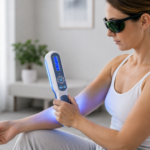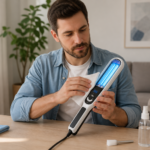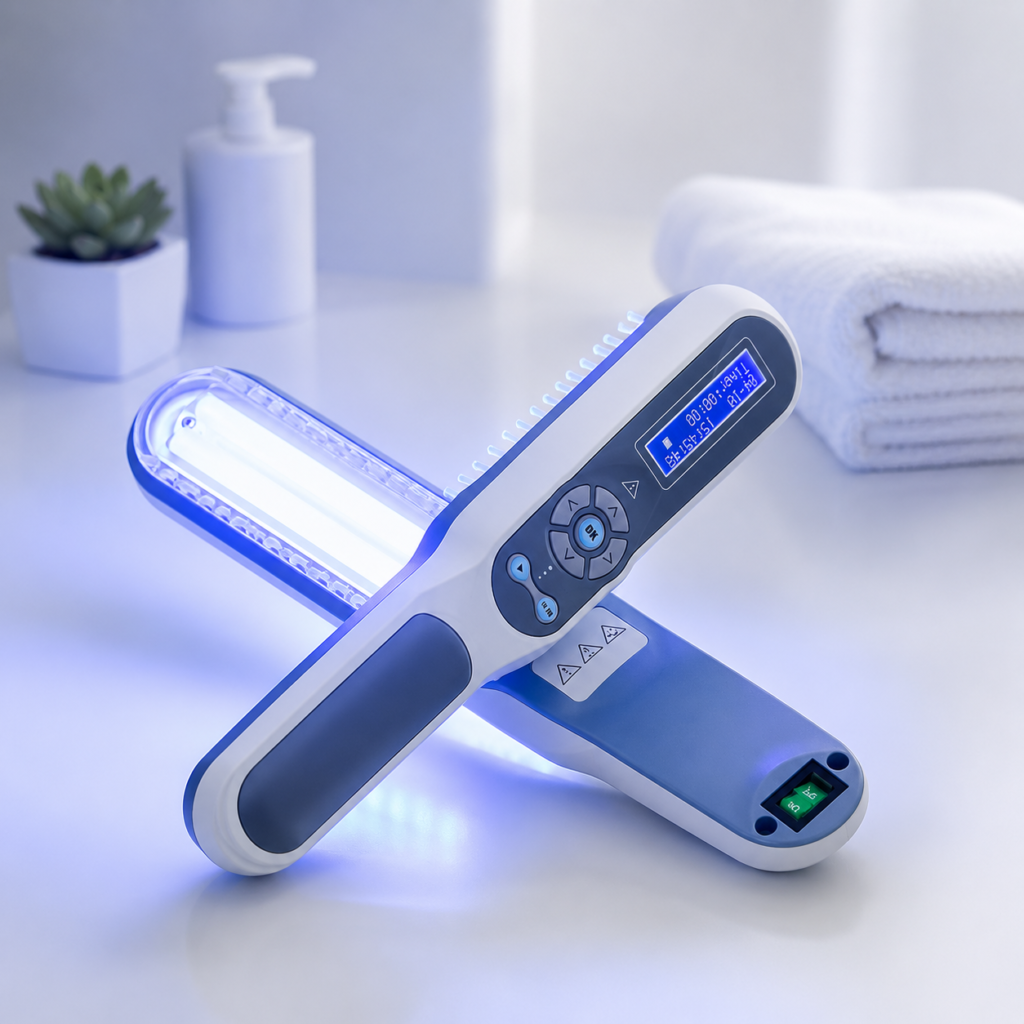

I get this question almost every week from patients starting home phototherapy – how long do UV lamps last? Most people want a number, a clean single figure for UV lamp lifespan that tells them exactly when the bulb is done. The honest answer is more layered. An ultraviolet tube can glow for years while its therapeutic output has already dropped well below the dose the device was built to deliver. The practical question is not when the lamp stops working, but when it stops working as prescribed.
What follows below is a practical breakdown: UV lamp hours across UVA, UVB, and UVC; the factors that chip away at UV light longevity; and the point where UV bulb replacement can no longer be postponed. Most of the detail concerns narrowband UVB at 311 nm, since that is the wavelength most patients using home phototherapy in the USA depend on. The physics carries over to sterilization and air-purification lamps too.
Typical Lifespan of UV Lamps
Rated UV lamp hours differ considerably depending on the spectral band:
-
The UVA range (315–400 nm) covers lamps used in PUVA therapy and tanning applications, with typical rated lifespans of 8,000 to 10,000 hours or more (1).
-
Older broadband UVB tubes (280–315 nm) last in the region of 6,000–8,000 hours, but clinical practice moved away from broadband years ago in favor of the more selective 311 nm output (2).
-
Narrowband UVB at 311–313 nm is the clinical reference standard for psoriasis, vitiligo, and atopic dermatitis. Philips PL-S 9W/01/2P and TL/01 tubes carry a nominal life around 1,000 hours. In practice, certified home-device manufacturers advise UV bulb replacement far earlier – somewhere in the 500 to 800 cumulative hour range – to keep the therapeutic dose consistent (3)(4).
-
For UVC germicidal lamps at 254 nm, typical UV disinfection lamp life falls in the 9,000–12,000 hour range. That works out to roughly twelve months of continuous service in HVAC installations, water-treatment units, and sterilization cabinets (5)(6).
-
UV-LED sources sit in a different category. Some reach 25,000 hours, and the output curve stays much flatter than a fluorescent tube’s across that service life (2).
Here is the piece patients almost always miss. A narrowband UVB tube loses around 15% of its output by 1,000 hours and close to 20% by 2,000 hours (3). It still emits at 311 nm. It still lights the cabinet. What changes is the dose per second, and without an adjustment to session length, every subsequent treatment runs a little under the one before it.
Factors That Affect UV Lamp Lifespan
Several variables shape how fast a UV tube loses performance:
-
On/off cycling. Every ignition erodes the cathode coating. Twelve brief daily starts age a lamp faster than one longer session of equivalent total time (7).
-
Ballast quality and voltage stability. In US households at 120 V, circuits shared with high-draw appliances produce voltage sags that stress electronic ballasts and shorten bulb life.
-
Operating temperature. Narrowband UVB tubes are specified for 5–40 °C under IEC 60601-2-57 conditions (8). Overheated housings accelerate phosphor degradation.
-
Dust and skin oils. A fingerprint on a quartz envelope creates a hotspot and attenuates UVB transmission. Settled dust filters the very wavelengths the lamp was built to emit (7).
-
Mercury vaporization. In low-pressure mercury-vapor lamps, combustion products deposit on the inner glass wall, reducing UV transmission steadily – the principal mechanism behind output decline (5).
Signs Your UV Lamp Needs Replacement
End-of-life is usually quiet – the lamp rarely fails outright. In practice, the signs I tell patients to watch for are:
-
Treatment times creeping upward. If a protocol that formerly produced a mild skin response now needs noticeably longer exposure, output has fallen.
-
Darkened bands at the tube ends, indicating electrode wear and mercury depletion (5).
-
Flickering at ignition or an unusually slow warm-up.
-
Built-in hour counter reaching the manufacturer’s replacement threshold. Home units such as the UVTREAT handheld UVB devices track cumulative hours for this purpose.
-
A Solarmeter 6.2 or comparable calibrated radiometer showing UVB irradiance below roughly 70% of the lamp’s original value.
How to Extend the Life of UV Lamps
Conscientious UV lamp care extends UV bulb duration without sacrificing clinical performance:
-
Handle tubes by the plastic base or ceramic ends only – skin oils damage the envelope surface.
-
Wipe with a dry, lint-free cloth when the device is cool and powered off. Avoid solvents unless the manual approves them.
-
Plug into a surge-protected outlet on a stable 120 V circuit. Skip extension cords and shared high-draw lines.
-
Use the integrated timer. Sessions that end precisely at the prescribed interval reduce unnecessary on-time.
-
Log the hours, either through the device counter or a paper log on the housing.
-
Store spare bulbs upright in original packaging, away from humidity.
How Often Should You Replace a UV Lamp?
Accepted replacement intervals for UV sterilizer maintenance and home phototherapy in UV lamps home USA:
-
Narrowband UVB phototherapy tubes: every 500–800 hours, or annually for routine household use (3)(4).
-
UVC disinfection and air-purification lamps: every 9,000–12,000 hours, or annually – whichever comes first (5)(6).
-
UVA lamps: approximately every 10,000 hours, per manufacturer specification (1).
Whichever limit arrives first – rated hours or elapsed time since install – is when the lamp should be replaced. Marking the install date on a sticker applied to the housing is the most reliable method, and I recommend it to every patient starting home therapy.
Choosing Long-Lasting UV Lamps
Build quality sets the ceiling on a UV lamp’s working life. A few markers matter:
-
FDA 510(k) clearance is the US regulatory benchmark for therapeutic UV devices (9)(10). The devices in the UVTREAT catalog, for example, are cleared under 510(k) K132643.
-
Quartz-glass envelopes. Standard glass absorbs therapeutic UVB; only quartz transmits 311 nm efficiently (4).
-
Genuine Philips PL-S or TL/01 tubes. More than 400 independent clinical studies have evaluated Philips narrowband lamps (3).
-
CE marking, for internationally sourced equipment.
-
A dedicated bulb warranty separate from the device warranty.
Conclusion
UV lamps rarely announce the end of their useful life. They decline gradually while still appearing to work. The practical discipline is straightforward: track the hours, keep the envelope clean, replace on schedule, and source replacement tubes only from manufacturers who publish their specifications. A well-maintained 311 nm lamp delivers its rated dose across its full lifespan. A neglected one slips out of specification well before it goes dark.
If your device is approaching its replacement window, review the manufacturer documentation and consider genuine Philips replacement bulbs before the output drop becomes clinically meaningful.
References
-
Philips Lighting. UV-B Narrowband PL-L and PL-S Product Family – Technical Specifications. Product Catalogue XUM01PL. https://www.lighting.philips.com/main/prof/conventional-lamps-and-tubes/special-lamps/various-uv-applications/uv-b/uv-b-narrowband-pl-l-pl-s
-
Wirick C. Phototherapy Devices: Where Is The Field Headed? Medical Device Online, 2023. https://www.meddeviceonline.com/doc/phototherapy-devices-where-is-the-field-headed-0001
-
Skin Matters Bristol. Philips UVB 311 Narrowband Replacement Lamps – Performance Data and Clinical Evidence. 2025. https://www.skinmattersbristol.com/product/philips-replacement-lamps-minimum-order-4-lamps/
-
Solarc Systems Inc. Frequently Asked Questions About UVB-NB Phototherapy. ISO-13485-certified manufacturer documentation, 2025. https://solarcsystems.com/information/faq-about-nb-uvb-phototherapy/
-
BSC Bulbs. How Long Do UV Lights Last? Technical Guide to UV Lamp Lifespan, Degradation, and Replacement. 2024. https://bscbulbs.com/blogs/bsc-blog/how-long-do-uv-lights-last-guide
-
Scott’s Heating and Air. How Often Should UV Lights Be Changed? HVAC UV Lamp Replacement Guidelines, 2026. https://www.scottsair.com/blog/2013/10/how-often-uv-lights-changed
-
Welly. Understanding Bulb Lifespan: How Often Should UVB Be Replaced? 2025. https://welly.it.com/understanding-bulb-lifespan-how-often-should-uvb-be-replaced
-
International Electrotechnical Commission. IEC 60601-2-57: Particular requirements for the basic safety and essential performance of non-laser light source equipment intended for therapeutic, diagnostic, monitoring, and cosmetic/aesthetic use. https://webstore.iec.ch/en/publication/2676
-
U.S. Food and Drug Administration. Ultraviolet Phototherapy Equipment: Medical Ultraviolet Lamps and Products. FDA Center for Devices and Radiological Health. https://www.fda.gov/radiation-emitting-products/surgical-and-therapeutic-products/ultraviolet-phototherapy-equipment-medical-ultraviolet-lamps-and-products
-
U.S. Food and Drug Administration. Premarket Notification 510(k) K223882: Narrowband UV Phototherapy Light Lamp. FDA Access Database. https://www.accessdata.fda.gov/cdrh_docs/pdf22/K223882.pdf