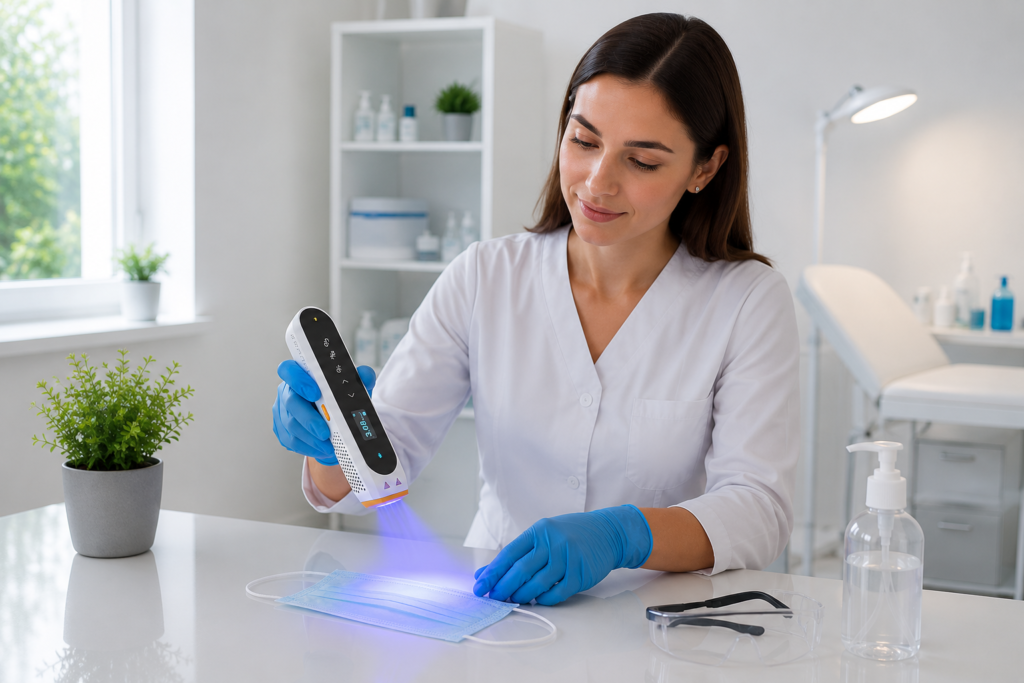

UV Lamps in Healthcare: Benefits and Risks
Introduction
UV-C in hospitals is back. Not the 1940s tuberculosis use case, but something more targeted: terminal room disinfection after discharge, continuous air treatment in occupied bays, supplemental sanitation between cases. The trigger was Anderson and the CDC-Epicenters group. Their automated UV-C tower study brought Clostridioides difficile, VRE, and Acinetobacter counts down to barely measurable on room surfaces after standard cleaning had finished (1). Federal guidance from FDA, EPA, and NIOSH has filled in since (3, 4, 6). The catch: uv lamps in healthcare are powerful, dose-dependent, and unforgiving when programs cut corners.
How UV Lamps Are Used in Healthcare
Three deployment patterns dominate U.S. facilities right now. Terminal disinfection. Continuous air treatment in occupied spaces. Supplemental sanitation between cases. Larger systems run two of them. The biggest run all three.
UV-C Light for Disinfection
The germicidal wavelength is 254 nm. Low-pressure mercury lamps produce it. Photons at that energy break microbial nucleic acid bonds and stop replication. Dose equals irradiance × exposure time. Clinical fixtures get spec’d to a validated J/m² output across the target surface inside a defined cycle. FDA has classified UV-C as a known disinfectant for nonporous surfaces, water, and air for decades (4).
Mobile UV Disinfection Units
How it actually runs: housekeeping finishes the discharge clean. Tower goes in. Door closes. Operator starts the cycle from a tablet in the corridor. The big trial here was Anderson again – BETR Disinfection, in Lancet Infectious Diseases. Multicenter, cluster-randomized, crossover. UV-C added on top of standard terminal cleaning produced statistically significant reductions in hospital-onset MDRO and C. difficile infections (2). VHA system data backed it up: stepped-wedge analysis across 128 hospitals registered a roughly 19% drop in gram-negative rod bloodstream infections post-rollout, with substantial site-to-site variability (8).
HVAC UV Systems in Clinics
Two flavors here. In-duct: lamps live inside the AHU casing, irradiance hitting the cooling coil and the airstream as it passes through. Coil biofilm control plus airborne dose, one installation. ANSI/ASHRAE published the testing methodology in two standards – 185.1 for airborne organisms, 185.2 for surface (7). Different geometry, second flavor: upper-room UVGI. Fixtures install at the 7-foot mark or higher in waiting areas, triage bays, TB rule-out spaces. The irradiated band sits up high. Convection and mechanical ventilation cycle lower-zone air through it and back down. Ceiling height matters as much as lamp wattage. NIOSH Publication 2009-105 covers the engineering parameters (3).
Benefits of UV Sterilization in Clinics
1. Reduces Pathogens Efficiently
Vegetative bacteria die within seconds at clinical irradiance. Spore-formers and non-enveloped viruses take longer dose. Anderson reported >99% reduction on contaminated room surfaces (1). A 2023 meta-analysis of nine U.S. studies produced mixed but largely positive results: significant cut in gram-negative rod infections, weaker and more variable signal on C. difficile and VRE (9).
2. Minimizes Manual Chemical Use
No residue. That is the practical advantage for uv sterilization clinics scaling up: less quat-and-bleach burden on rubber gaskets, monitor faces, powder-coat finishes. Corrosion picture improves. Liquid disinfectant consumption usually drops once UV-C goes in as an adjunct.
3. Improves Air Quality
Airborne mycobacterial counts fall under upper-room UVGI. That is the entire NIOSH 2009 evidence base in one sentence (3). Bench testing also shows reduction of influenza and SARS-CoV-2 surrogates by properly tuned uv air purification clinics installations.
4. Supports Infection Control Protocols
Cycle programmability strips operator variability out of the picture. Audit logs prove the cycle ran. Remote start keeps staff out of the irradiated zone. That is the reason uv disinfection hospitals fold UV-C into bundle programs rather than treat it as a standalone substitute for housekeeping.
Risks and Limitations of Medical UV Light
UV Exposure Risks for Staff and Patients
Photokeratitis and erythema can show up in seconds of direct exposure. FDA describes the ocular injury bluntly: severe pain, sand-in-the-eyes sensation, usually clearing inside 24–48 hours once exposure stops (4). The same agency has named specific consumer-grade UV wands that emit over 3,000× the international exposure limit at typical hand-held distance (5). Worth restating: uv light health risks scale with dose. They do not differentiate between operator, patient, and bystander.
Material Degradation
Polymer response is wildly uneven. NIST work on damage to common healthcare polymer surfaces puts polypropylene and UHMW-PE at the stable end (10). At the damaged end: ABS, nylon, polycarbonate, white acrylic. PVC and PLA degrade fastest, particularly within a meter of the source. Any mobile-unit program needs a material compatibility list before launch.
Operational Limitations
Line-of-sight only. The underside of bed rails, the back of monitor brackets, drawer cavities, anywhere a cable run blocks the optical path – none of that gets dose. Some lamp chemistries emit below 240 nm and generate ozone. FDA flags ozone as an airway irritant in sensitive occupants (4). Pre-cleaning still required. Organic soil absorbs UV photons before they reach the pathogen layer underneath.
Safety Protocols for Healthcare UV Use
Room Preparation
Personnel out before activation. Cover or remove anything sensitive: exposed electronics, latex, patient belongings. Signage on the door. Electromechanical interlocks set to kill the cycle if anyone enters.
Proper PPE
For commissioning and any task where stray UV cannot be excluded: UV-rated polycarbonate goggles, long sleeves, gloves. CDC/NIOSH sets the recommended exposure limit at 254 nm at 6 mJ/cm² per 8-hour shift (3).
Automation and Sensors
Motion sensing. Door-position sensing. A timed cycle the operator cannot bypass mid-run. Tablet-based remote start. Logged completion data for chain-of-custody and audit trail. That is the safety stack on any clinical-grade unit.
Choosing UV Systems for Clinics
Regulatory Standards
Three overlapping U.S. frameworks apply. FDA reviews units that meet the medical-device definition (4). EPA regulates antimicrobial efficacy claims under FIFRA, with a 2020 compliance advisory still in effect (6). UL covers electrical safety. Buyers verify all three before signing.
Types of UV Devices
Form factors: mobile robots, fixed upper-room fixtures, in-duct HVAC arrays, hand-held wands (FDA has flagged most consumer wand models as unsafe), enclosed chambers for instruments. Hospital uv-c systems built for clinical use are validated, networked, and serviceable. Most consumer wands are none of those things.
Maintenance Requirements
Lamp output declines with operating hours. Plan replacement at 8,000–9,000. Quartz sleeves: wipe on interval. Output: verify with an irradiance meter, not by eye. Motion sensors: test on schedule, not on feel. Functional uv disinfection equipment programs put re-validation on the calendar from day one.
UV Lamps vs. Other Hospital Disinfection Methods
Sodium hypochlorite remains the C. difficile contact-time reference. Trained labor required, residue left behind. Hydrogen peroxide vapor reaches shadowed corners better than UV-C, at the cost of much longer room turnaround. HEPA filtration captures particles without inactivating the organisms riding inside them. Autoclave steam sterilizes what fits in the chamber. Each method handles what the others miss. That positioning is exactly why medical uv sterilization shows up in CDC and ASHRAE documents as an additive layer rather than a substitute.
Conclusion
The evidence base under clinical UV-C is solid. Multicenter trials. Federal guidance from FDA and NIOSH. About a decade of post-deployment data from U.S. systems. None of that makes it plug-and-play. Hospitals seeing the strongest gains pair certified hardware with trained staff, validated cycles, and a real maintenance budget. Hospitals that buy a box and skip the program work usually pay in injured personnel and unchanged HAI numbers.
References
-
Anderson DJ, Gergen MF, Smathers E, et al. Decontamination of targeted pathogens from patient rooms using an automated ultraviolet-C-emitting device.
-
Anderson DJ, Chen LF, Weber DJ, et al. Enhanced terminal room disinfection and acquisition and infection
-
NIOSH. Environmental Control for Tuberculosis: Basic Upper-Room Ultraviolet Germicidal Irradiation Guidelines for Healthcare Settings. DHHS (NIOSH) Publication No. 2009-105. https://www.cdc.gov/niosh/docs/2009-105/
-
U.S. Food and Drug Administration. https://www.fda.gov/radiation-emitting-products/tanning/ultraviolet-uv-radiation
-
U.S. Food and Drug Administration. Do Not Use Ultraviolet (UV) Wands That Give Off Unsafe Levels of Radiation: FDA Safety Communication. July 20, 2022.
-
U.S. Environmental Protection Agency. Compliance Advisory: EPA Regulations About UV Lights That Claim to Kill or Be Effective Against Viruses and Bacteria. Publication 305-F-20-004, October 2020.
-
ANSI/ASHRAE Standard 185.1, Method of Testing UV-C Lights for Use in Air-Handling Units or Air Ducts to Inactivate Airborne Microorganisms; ANSI/ASHRAE Standard 185.2, Method of Testing UV Lamps for Use in HVAC&R Units or Air Ducts to Inactivate Microorganisms on Irradiated Surfaces.
-
Kovach KJ, Hopkin AS, Stamm AM, et al. Effectiveness of Ultraviolet-C Disinfection on Hospital-Onset Gram-Negative Rod Bloodstream Infection: A Nationwide Stepped-Wedge Time-Series Analysis. Clin Infect Dis. 2023;76(4):e1296–e1304.
-
Systematic review and meta-analysis: Effectiveness of ultraviolet-C disinfection systems for reduction of multi-drug resistant organism infections in healthcare settings. PMC10540170, 2023.
-
Teska P. Damage to Common Healthcare Polymer Surfaces from UV-C Exposure. NIST poster / Nano LIFE 2020.

![¿Qué es la libido femenina y cómo recuperarla? [+Consejos]](https://beautysecretskin.com/wp-content/uploads/2026/10/que-es-libido-femenina-150x150.jpeg)