
Introduction
UV lamps don’t ask for much, but the little they do ask for matters. A monthly wipe and an honest replacement schedule keep them disinfecting at full strength. Forget about uv lamp maintenance and the unit can quietly drop most of its germicidal output while the bulb still lights up the same as ever (1).
This piece covers cleaning uv lamps inside an average home – bulbs, sleeves, schedules, and the safety details most product manuals gloss over.
Why UV Lamp Maintenance Is Important
The physics is simple. UV-C rays sterilize only what they actually reach. Coat the bulb in a haze of dust or skin oil and you’ve blocked the light before it can touch anything (2).
A few practical consequences follow from that.
First, there’s the disinfection itself. A clean lamp puts out its full 254 nm dose. A grimy one cannot, even if it looks fine to the eye.
Second, lifespan. Heat trapped under fouling stresses the bulb envelope and ages the ballast faster than it should. According to one industry estimate, UV-C intensity drops somewhere between 40 and 60 percent across the typical 9,000-hour service life, and neglected lamps lose that intensity sooner (3).
Energy is the third issue. Wattage stays constant. Useful output falls. The math doesn’t favor you.
For anyone running a portable countertop sterilizer, an in-duct HVAC fixture, or a small commercial unit, uv sterilizer maintenance and home uv lamp maintenance aren’t optional extras. They’re the reason the device works at all.
Safety Precautions Before Cleaning
UV-C burns happen fast. The FDA has documented eye injuries and skin reactions from just a few seconds of direct exposure (4). So before any cleaning starts:
Pull the plug from the wall. The on/off switch isn’t enough – some units stay powered through standby circuits.
Wait. Ten to fifteen minutes, minimum. Hot quartz cracks if you touch it with a cool damp cloth.
Glove up with nitrile. Skin oils don’t wipe off quartz the way fingerprints come off a window. They bake in the next time the bulb fires.
Cover your eyes. Regular sunglasses do nothing for UV-C. Use polycarbonate UV-blocking lenses or a proper face shield.
Ventilate the workspace. Some bulbs emit small amounts of ozone, and the older mercury-vapor types can leak trace mercury if cracked (4).
Move kids and pets to another room. There’s no good reason to have them nearby while the housing is open.
UV light safety is one of those areas where the FDA has actively warned consumers, particularly about UV wands sold online with no shielding or proper labeling (5). Even devices that are fully compliant still need careful handling.
How to Clean UV Lamps Properly
This is the standard procedure for how to clean uv light fixtures at home. It applies to most certified consumer UV-C equipment: air purifiers, surface sterilizers, point-of-use water units.
Start with the device unplugged and cold. Verify both. Then gear up with gloves and eye protection and open the housing per the manual.
When you remove the bulb, hold it by the ceramic end caps. Never the glass. Set it on a clean cotton towel rather than a hard counter.
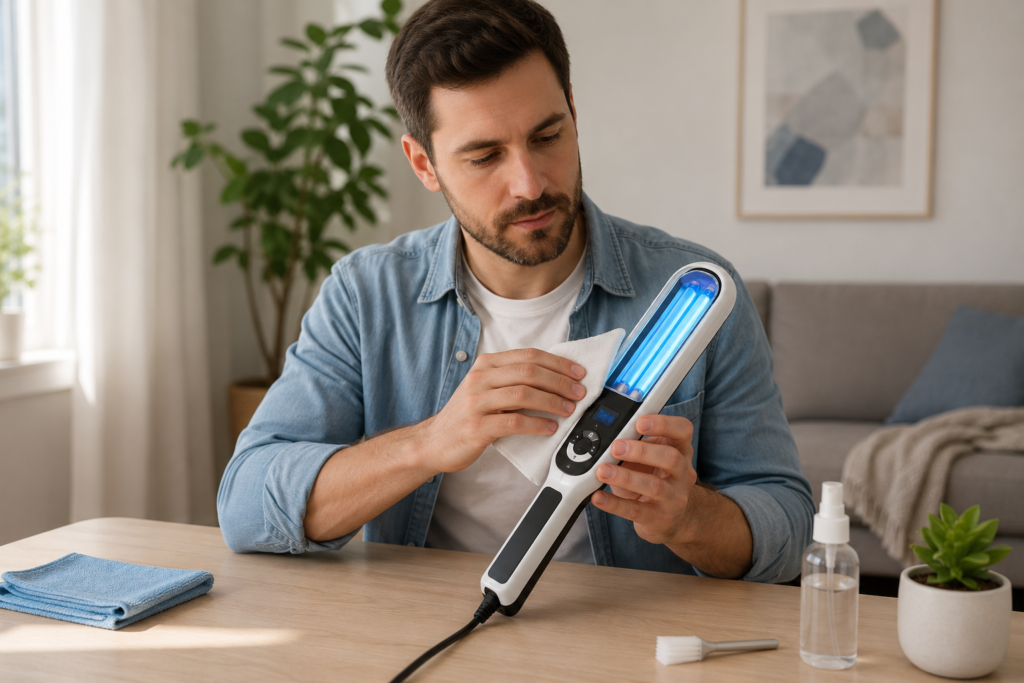
Take a lint-free cloth or cotton pad and moisten it with 70%+ isopropyl alcohol. Wet, not dripping. Pouring alcohol directly onto the lamp risks running fluid into the socket.
Wipe end to end, rotating the bulb as you go. Eight to ten passes covers most light fouling (6).
Quartz sleeves on water units need a different approach. Mineral scale doesn’t yield to alcohol. Use a cloth dampened with white vinegar or a weak citric-acid solution, then rinse with distilled water and dry thoroughly before reassembly (7).
Inspect what you’ve cleaned. Dark spots that didn’t come off, hairline cracks, discoloration along the electrodes – any of those mean replacement, not reinstallation.
Let air-drying do its job. Five minutes is fine. Reassemble. Power up. Run a test cycle in an empty room.
A short list of things not to do:
-
Spraying cleaner into the housing
-
Bleach, ammonia, or scented disinfectant wipes
-
Reassembly while anything is still damp
Maintenance Schedule for UV Lamps
uv disinfection lamp cleaning routines should match the environment. A kitchen-counter unit in a household with shedding pets fouls quickly. A sealed HVAC fixture in a clean basement might go months without needing attention.
That said, a reasonable baseline schedule looks like this:
|
Task |
Frequency |
Notes |
|
Visual inspection |
Weekly |
Look for dust, fingerprints, discoloration |
|
Bulb wipe with alcohol |
Monthly |
More often in dusty environments |
|
Quartz sleeve cleaning |
Quarterly |
Or when mineral haze appears |
|
Bulb replacement |
Every 8,000–10,000 hours, or annually |
Whichever arrives first (8) |
|
Quartz sleeve replacement |
Every 2–3 years |
Even if it looks transparent |
|
Whole-system check |
Annually |
Ballast, wiring, gaskets, seals |
The replacement column is where most owners go wrong. UV-C bulbs don’t fail dramatically. Output slips quietly. A bulb at hour 11,500 may glow as brightly as the day it shipped, yet put out a small fraction of the germicidal dose it produced when new (1). The running-hour count is the honest number here, not what your eyes report.
Common Mistakes to Avoid
The same handful of errors shows up over and over in shortened bulb life.
Touching the glass with bare fingers. The damage isn’t immediate, but the next time the lamp heats up, those oils carbonize into permanent dark patches.
Reaching for household cleaners. Skip household cleaners entirely. Ammonia-based sprays, bleach solution, scented wipes – they all leave residues that the bulb’s heat then bakes into a film on the quartz.
Running the unit without its protective shield in place. Open UV-C exposure is the fastest route to corneal damage you’ll find outside of arc welding.
Wiping a warm bulb. Quartz tolerates heat. It does not tolerate sudden temperature changes.
Trusting your eyes over the hour meter. If the device tracks runtime, use that number.
Buying generic replacement bulbs. Output specs vary widely between certified and uncertified bulbs even at the same wattage, and the cheap option often produces only a fraction of the rated UV-C dose. FDA-registered or CE-marked replacements matched to the device are worth the price difference.
Tips to Extend the Life of Your UV Lamp
Some habits genuinely move the needle on uv bulb care and overall uv lamp upkeep.
Run the lamp through a surge protector. American household power is fairly stable at 110–120 V, but ballasts have no tolerance for spikes.
Stop cycling the unit on and off all day. Low-pressure mercury lamps were designed for steady runs, and each ignition wears down the electrodes (9). A timer set for one or two longer cycles is gentler on the bulb than ten short ones.
Keep the surrounding area reasonably dust-free. Less ambient debris means less fouling between cleanings.
Write the installation date on the housing in permanent marker. Calendar reminders get dismissed; the marker survives.
Keep spare bulbs in their original packaging until you need them, and store them somewhere dry. Humidity damages the seals.
None of this is dramatic, but the cumulative effect across a multi-year service life is significant.
Conclusion
Maintaining uv disinfection systems is the kind of task that rewards consistency over effort. Wipe the bulb once a month. Replace it when it hits its hour count. Treat UV-C with the same caution you’d give any other source of radiation in the home. Do those three things and the device will keep delivering full disinfection for its rated lifetime. Skip them and you end up with a unit that lights up reassuringly while actually doing very little. A laminated checklist near the device is usually all that stands between the two outcomes.
References
-
Coospider. Lifespan and Replacement: How Often Should You Replace Your UV Disinfection Lamp to Ensure Effectiveness? (2026).
-
U.S. Department of Energy, Better Buildings Solution Center. Clean Ultraviolet Lamp Sleeves Regularly to Enhance UV Disinfection Performance. Wastewater Tipsheet #6, December 2021.
-
Hydro Services. UV Replacement Frequency Explained.
-
U.S. Food and Drug Administration. UV Lights and Lamps: Ultraviolet-C Radiation, Disinfection, and Coronavirus.
-
U.S. Food and Drug Administration. Beware of Ultraviolet Wands That Give Off Unsafe Levels of UV Radiation. Consumer Update, 2022.
-
Alpha Cure. Maintenance Tips for Prolonging the Life of Your UV Lamps (2024).
-
ESP Water Products. How to Clean a UV Quartz Sleeve for a Water Disinfection System.
-
Crystal IS. Considering UVC LED Lifetime Based on Operating Hours.
University of Rochester Environmental Health & Safety. UV Light Guidelines.