
The 2024 Light Treatment Effectiveness (LITE) trial enrolled 783 patients across 42 U.S. dermatology practices and reported that home-based narrowband UVB produced clearance rates equal to office-based phototherapy, with better adherence and lower patient cost (1). For patients who drive an hour each way for a three-minute session, that finding reshapes the treatment plan.
Still, “approved for home use” is not the same as “safe under any circumstances.” When the unit is FDA-cleared, the prescription is written by a dermatologist, and the dosing is respected, home uv lamp skin therapy is a mature and well-documented treatment. When any of those pieces is missing, the risks become real. This guide covers the mechanism, the clinical risks worth knowing, and the criteria that set a certified uv skin lamp apart from an unregulated import.
How UV Lamps Work for Skin Therapy
UV radiation comes in three bands. UVA (315–400 nm) penetrates deepest and reaches the dermis. UVB (280–315 nm) is the workhorse wavelength – absorbed in the epidermis, where most chronic inflammatory disease lives. UVC is blocked by the atmosphere and shows up clinically only from artificial sources such as germicidal lamps (2).
Medical phototherapy focuses on a very narrow UVB window. The TL-01 lamp, peaking at 311–313 nm, was developed after work by Parrish and Jaenicke in the early 1980s showed that this wavelength cleared psoriatic plaques while producing far less erythema than the older broadband UVB sources (3). About 90 percent of its output is absorbed in the epidermis. What follows – T-cell apoptosis, suppression of the IL-23/IL-17 axis driving psoriasis, and reactivation of dormant melanocytes – is what makes a narrowband UVB 311 nm lamp useful for uv lamp psoriasis and uv lamp vitiligo. Visible-light LED devices do something different, and I address those separately below.
Potential Risks of UV Skin Lamps
Most patients tolerate narrowband UVB well. The commonest acute complaint is a mild sunburn-type erythema, sometimes with dryness or itching in the week after a session. That is also why NB-UVB replaced broadband UVB in most clinics – the narrower spectrum is roughly five to ten times less erythemogenic (4). Photoaging and hyperpigmentation can appear with long cumulative exposure, particularly in Fitzpatrick phototypes IV–VI.
Skin cancer is the concern patients raise most often. The IARC classifies UV radiation as a Group 1 carcinogen – that is settled. What is less settled is whether therapeutic NB-UVB at prescribed doses translates that hazard into an actual clinical signal. A 2024 retrospective cohort of 3,506 patients found no increase in melanoma, squamous cell carcinoma, or basal cell carcinoma, and no dose–response with cumulative UVB (5). A Finnish registry of 4,815 patients reported higher incidence ratios and remains the principal outlier; the authors asked for confirmation before the result is generalized (6). The short version: NB-UVB as used in modern dermatology does not behave like tanning-bed UVA, though the data are not a blanket exoneration.
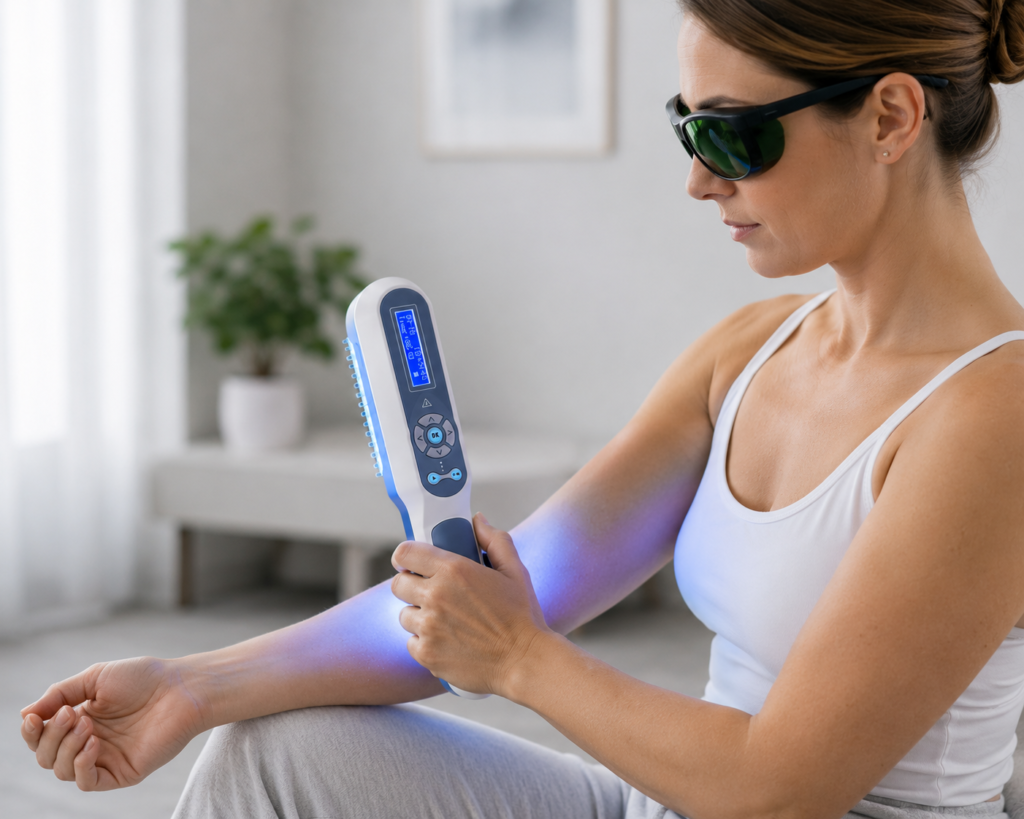
Eyes are the risk patients most often underestimate. Wavelengths between 295 and 320 nm drive cataract formation, with 300 nm the most potent (4). Direct corneal exposure to narrowband UVB can trigger photokeratitis in roughly half a minute. Certified goggles go on every session. Regular sunglasses do not qualify.
On the electrical side, an FDA-cleared phototherapy device has to clear IEC 60601-1, IEC 60601-2-57, and IEC 62471 – a stack that does not apply to UV-C disinfection wands sold online. The FDA has tested many of those wands and found emission up to three thousand times above international exposure limits (7, 8).
Some patients should not use UV phototherapy at all. Xeroderma pigmentosum, lupus erythematosus, porphyria, current photosensitizing medication, or a personal history of melanoma are contraindications (9). Treatment is also held during active skin infection, open wounds, or acute sunburn.
Best Practices for Safe Home Use
Safe home phototherapy is mostly about discipline. A safe uv skin lamp protocol rests on a handful of non-negotiable points:
-
A dermatologist prescribes the course. Home NB-UVB devices in the U.S. are Class II under 21 CFR 878.4630 and prescription-only under 21 CFR 801.109 (10).
-
Goggles rated for the specific wavelength, every session. Genital shielding too – the site with the clearest historical link to UV carcinogenesis (4).
-
Fitzpatrick dosing per the AAD–NPF guideline: 300 mJ/cm² for types I–II, 500 mJ/cm² for types III–IV, 800 mJ/cm² for types V–VI, with 5–10 percent increments per visit (3).
-
Plaque psoriasis usually runs on a thrice-weekly schedule; vitiligo protocols typically settle at two to three sessions per week.
-
Respect the lamp-to-skin distance in the manual, and change bulbs when the manufacturer says so – most specify replacement at about 350 treatment hours.
-
Salicylic acid before a session reduces UVB efficacy. Review every photosensitizing medication with the prescriber.
-
Keep a session log. Date, duration, dose, any erythema that followed. That record is what lets a dermatologist adjust the protocol without guesswork.
UV vs LED Lamps for Skin Therapy
UV and LED devices often sit on the same shelf at consumer retailers, which causes confusion. Mechanically, they are not the same tool.
|
Feature |
Narrowband UVB |
Visible-light LED |
|
Wavelength |
311–313 nm |
405–420 nm (blue); 630–660 nm (red) |
|
FDA status |
Class II, prescription |
Class II, OTC-cleared for many home units |
|
Primary indications |
Psoriasis, vitiligo, atopic dermatitis |
Mild-to-moderate inflammatory acne; photoaging |
|
Mechanism |
DNA-level immunomodulation; melanocyte stimulation |
Porphyrin excitation in C. acnes; photobiomodulation |
|
Carcinogenic potential |
IARC Group 1; evidence inconsistent for NB-UVB alone |
No UV emission; no documented carcinogenic risk |
For uv therapy for skin, NB-UVB treats disease – immune dysregulation, depigmentation, inflammation at the epidermal level. LED is doing something else entirely. Worth underlining: uv lamp acne is a misnomer as a treatment category. A systematic review found 407–420 nm blue light, not UV, to be the FDA-cleared light-based option for mild-to-moderate inflammatory acne, working through bacterial porphyrin excitation (11). The American Academy of Dermatology advises against UV-based acne treatment given the risk–benefit profile (12).
Top UV Lamps for Skin Therapy (2026 Edition)
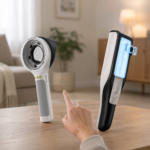
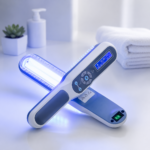
Most of the uv lamps USA patients bring to their dermatologist in 2025 fall into four practical categories. Handheld 311 nm NB-UVB units are the go-to for localized plaques, focal vitiligo patches, and scalp disease. Dual-lamp handheld units cover a larger field in less time and suit bilateral or truncal involvement. 308 nm excimer systems aim a high-intensity beam at lesional skin only; the excimer laser is FDA-cleared for chronic localized psoriasis and used off-label for stable vitiligo (3). Panel and cabinet units are the full-body option – these were used in the LITE trial’s home-based arm (1).
Among the best uv lamps 2025, a legitimate product always comes with paperwork you can verify: a 510(k) clearance number, a stated peak wavelength, IEC 60601-1 and IEC 62471 compliance, ISO 10993 biocompatibility testing for anything that touches skin, and eye protection in the box.
Tips for Choosing a UV Lamp for Home Skin Therapy
Before signing off on a device, I run through five checks with patients:
-
Pull up the FDA 510(k) number in the public database. The cleared indication has to match the working diagnosis.
-
Check the wavelength. Narrowband UVB at 311–313 nm for psoriasis and vitiligo, 308 nm excimer for focal work. A UVA tanning unit cleared under 21 CFR 878.4635 does not substitute for medical phototherapy (13).
-
Confirm the certification stack: UL, FDA, IEC at minimum, and CE for imported units.
-
Check the sales workflow. A U.S. company that skips the prescription step is not operating within the rules.
-
Look at the controls. Built-in timers, pre-programmed Fitzpatrick dosing, and clean displays prevent the single most common home adverse event: accidental overdose.
Conclusion
Narrowband UVB at home is a real option for psoriasis, vitiligo, and atopic dermatitis. It is also a medical device that demands medical discipline – a written prescription, wavelength-matched goggles, proper dosing for skin phototype, and an honest log of what happens between sessions. Tanning beds and UV-C disinfection wands are not in the same category. For acne, LED is the right light-based tool; UV is not. The LITE data now let a dermatologist offer a certified 2025 home device as a legitimate first-line choice for the right patient.
References
-
Gelfand JM, Armstrong AW, Lim HW, et al. Home- vs Office-Based Narrowband UV-B Phototherapy for Patients With Psoriasis: The LITE Randomized Clinical Trial. JAMA Dermatol. 2024. PMID: 39319513. https://pubmed.ncbi.nlm.nih.gov/39319513/
-
U.S. Food and Drug Administration. Ultraviolet (UV) Radiation. https://www.fda.gov/radiation-emitting-products/tanning/ultraviolet-uv-radiation
-
Elmets CA, Lim HW, Stoff B, et al. Joint American Academy of Dermatology–National Psoriasis Foundation guidelines of care for the management and treatment of psoriasis with phototherapy. J Am Acad Dermatol. 2019;81(3):775-804. https://www.jaad.org/article/S0190-9622(19)30637-1/fulltext
-
Valejo Coelho MM, Apetato M. The dark side of the light: Phototherapy adverse effects. Clin Dermatol. 2016. PMID: 27638433. https://pubmed.ncbi.nlm.nih.gov/27638433/
-
Wang E, Ahad T, Liu YA, et al. Incidence and profile of skin cancers in patients following ultraviolet phototherapy without psoralens: A retrospective cohort study. J Am Acad Dermatol. 2024;90(4):759-766. PMID: 38070541. https://pubmed.ncbi.nlm.nih.gov/38070541/
-
Archontaki M, Jansen CT, Kaartinen I, et al. Skin Cancer Risk of Narrow-Band UV-B (TL-01) Phototherapy: A Multi-Center Registry Study with 4,815 Patients. https://pmc.ncbi.nlm.nih.gov/articles/PMC11040590/
-
U.S. Food and Drug Administration. 510(k) Premarket Notification K223882: Narrowband UV Phototherapy Light Lamp. https://www.accessdata.fda.gov/cdrh_docs/pdf22/K223882.pdf
-
U.S. Food and Drug Administration. Do Not Use Ultraviolet (UV) Wands That Give Off Unsafe Levels of Radiation: FDA Safety Communication. https://www.fda.gov/medical-devices/safety-communications/do-not-use-ultraviolet-uv-wands-give-unsafe-levels-radiation-fda-safety-communication
-
American Academy of Dermatology. Psoriasis treatment: Phototherapy. https://www.aad.org/public/diseases/psoriasis/treatment/medications/phototherapy
-
National Psoriasis Foundation. Light Therapy for Psoriasis. https://www.psoriasis.org/phototherapy/
-
Scott AM, Stehlik P, Clark J, et al. Blue-Light Therapy for Acne Vulgaris: A Systematic Review and Meta-Analysis. Ann Fam Med. 2019;17(6):545-553. https://pmc.ncbi.nlm.nih.gov/articles/PMC6846280/
-
American Academy of Dermatology. Lasers and lights: How well do they treat acne? https://www.aad.org/public/diseases/acne/derm-treat/lasers-lights
-
Federal Register. General and Plastic Surgery Devices: Reclassification of Ultraviolet Lamps for Tanning. Final Order, June 2, 2014. https://www.federalregister.gov/documents/2014/06/02/2014-12546/general-and-plastic-surgery-devices-reclassification-of-ultraviolet-lamps-for-tanning-henceforth-to