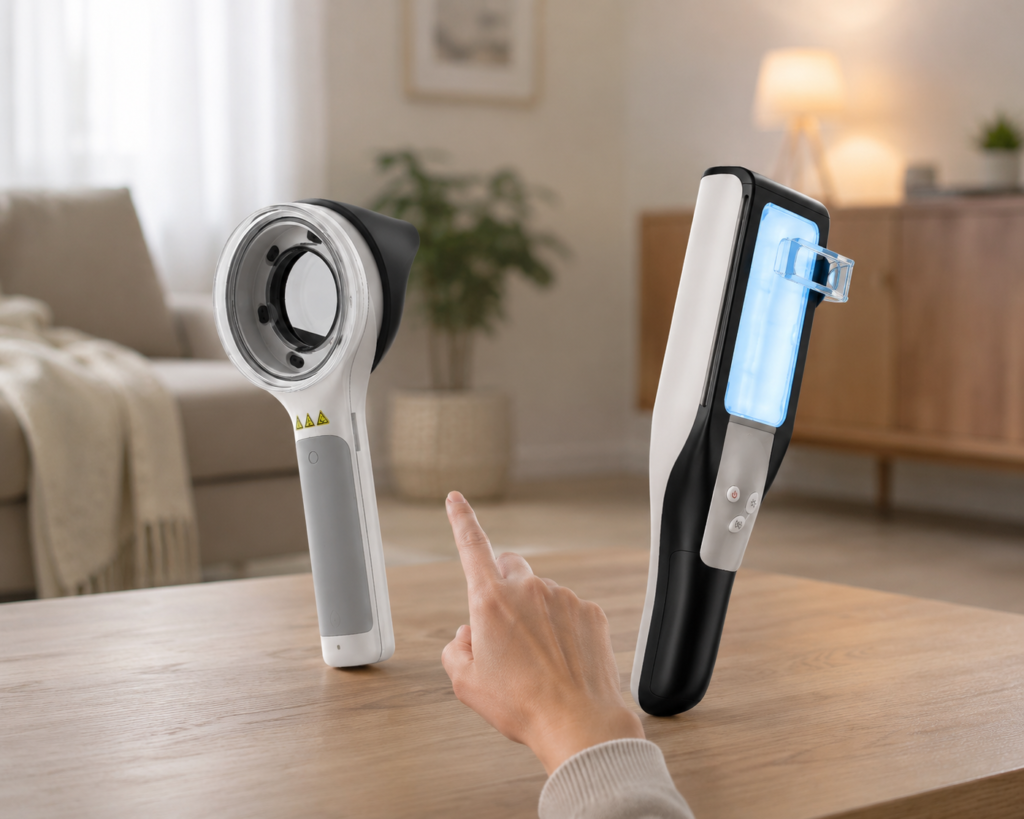

Narrowband UVB phototherapy has held its place in dermatology for more than three decades, and demand for home devices has climbed sharply since the 2024 LITE randomized trial confirmed that home and office phototherapy produce equivalent outcomes across all skin types (1). Patients looking to buy UV lamps USA now face a crowded market of prescription devices, FDA-cleared panels, and handheld wands sold through online distributors. This guide reviews the best UV lamps 2025 has to offer for skin therapy, with attention to emission wavelength, regulatory status, and the clinical realities of treatment at home.
How UV Lamps Work for Skin Therapy
The therapeutic effect of any UV skin lamp depends almost entirely on its emission spectrum. Narrowband UVB, peaking at 311–312 nm, suppresses the hyperactive T-cell population that drives psoriatic plaque formation and triggers apoptosis in affected lymphocytes (2). Broadband UVB (290–320 nm) achieves similar immunomodulation but carries a steeper erythema risk per therapeutic dose. UVA wavelengths (320–400 nm) penetrate deeper and require photosensitizing psoralens to exert a clinical effect, which is the basis of PUVA therapy.
Narrowband UVB is currently the first-line phototherapy for plaque psoriasis, vitiligo, and refractory atopic dermatitis in every major dermatology guideline (2, 3, 4). Its mechanism operates through the IL-23 and Th17 signaling axis, shifting the cutaneous cytokine balance toward regulatory T-cell activity – which partly explains why remission often outlasts the treatment course by months.
LED technology works on a different principle. LED skin devices emit visible light at 415 nm or 633 nm, activate bacterial porphyrins or cellular chromophores, and carry no ultraviolet component. A blue LED is not a UV lamp, and modern phototherapy for acne vulgaris has moved away from UV exposure toward targeted 415 nm activation of Cutibacterium acnes porphyrins (7). The distinction matters when reading product listings: “light therapy” and “UV therapy” are not interchangeable.
Top UV Lamps to Buy in 2026 (USA)
Device selection depends on three practical variables – affected surface area, anatomical location, and whether treatment will be delivered in a clinic or at home. Every device listed below uses a genuine Philips medical-grade narrowband tube as its emission source, which remains the irradiance benchmark cited in North American phototherapy programs.
UV Lamps for Psoriasis
For plaques covering more than 10% of body surface area, a full-body cabinet delivers the fastest and most uniform exposure. The Daavlin 7 Series – the device chosen for the LITE trial (1) – features double-door geometry that halves treatment time and integrating dosimetry that compensates for lamp aging. SolRx E-Series panels from Solarc Systems offer a modular alternative, configurable from a single 2-bulb master unit up to a 10-bulb wraparound booth. For patients with localized disease, the Kernel KN-4006BL1D portable unit pairs two Philips 311 nm lamps with a digital timer, making it a practical fit for knees, elbows, forearms, and lumbar plaques. Our home phototherapy guide for psoriasis covers dosing protocols in more depth.
UV Lamps for Vitiligo
Repigmentation rewards precise wavelength and patient persistence. Targeted 308 nm excimer devices – XTRAC being the dominant clinic system – can accelerate facial repigmentation, although a 2017 meta-analysis by Bae and colleagues found no statistically significant advantage over NB-UVB for ≥50% repigmentation when treatment courses were matched (5). For home use, the Kernel KN-4003BL handheld and the Daavlin DermaPal wand both deliver 311 nm NB-UVB in a portable format suitable for segmental or localized vitiligo on the face, hands, and neck.
UV Lamps for Acne (Important Clarification)
The category needs a clinical correction. The FDA-cleared devices currently marketed for acne – Omnilux Clear and comparable LED masks – use 415 nm blue light and 633 nm red light, both in the visible spectrum, with no UV output (7). UV exposure is no longer a recommended intervention for acne vulgaris given its side-effect profile relative to modern alternatives. Patients asking for a “UV lamp for acne” should be directed to a blue LED device, topical retinoids, or benzoyl peroxide under dermatologist supervision.
Portable UV Skin Lamps
Handheld devices address scalp psoriasis, hand and foot dermatoses, and isolated lesions. The Kernel KN-4003BL wand includes a scalp comb attachment that parts hair to deliver direct skin contact, which is essential because UVB does not penetrate through hair. The SolRx 100 Series handheld uses two Philips PL-S9W/01 bulbs – the highest handheld irradiance currently available – and accepts an optional positioning arm for hands-free use. The Daavlin DermaPal remains the most widely prescribed scalp wand in U.S. dermatology practice.
Where to Buy UV Lamps in the USA
Every home UV device sold legally in the United States is a prescription device under 21 CFR 801.109 (9). The requirement is federal: a licensed clinician must authorize the purchase through a written order or letterhead letter. Authorized distributors – Daavlin/Phothera, Solarc Systems, UVTREAT, DDP Medical, and National Biological Corporation – handle the prescription workflow, warranty, and FDA-compliant shipping. Marketplace listings on Amazon and similar platforms frequently bypass prescription verification, which is a compliance risk for the buyer.
Before purchasing UV lamps online, verify the FDA 510(k) clearance number against the FDA device database, confirm the bulb is a Philips medical narrowband tube, and check that the seller supplies UV-blocking goggles rated for 250–400 nm. For insured patients, home UV therapy systems are billed under HCPCS codes E0691 through E0694 depending on format (10), and most commercial plans and Medicare cover these devices with documented medical necessity – details are outlined in our reimbursement guide.
UV vs LED Lamps for Skin Therapy
The two technologies are not interchangeable. UV phototherapy treats immune-mediated skin disease – psoriasis, vitiligo, eczema, cutaneous T-cell lymphoma, refractory pruritus. LED photobiomodulation addresses superficial concerns: acne, age-related changes, and adjunctive wound healing. A home UV lamp for psoriasis will not improve inflammatory acne, and a consumer LED mask will not clear a psoriatic plaque. Irradiance levels differ by roughly an order of magnitude, and LED devices operate outside the action spectrum of any UV-responsive dermatosis.
For immune-mediated disease, UV remains the reference standard. For cosmetic concerns and mild inflammatory acne, LED is the safer, non-ionizing choice. The two modalities are complementary rather than competitive.
Tips for Safe Use of UV Lamps at Home
UV-blocking goggles are mandatory for every session, without exception. Acute photokeratitis can develop from seconds of unprotected exposure to a narrowband tube, and chronic unshielded exposure raises the risk of pterygium and cataract formation (3). Dosing should begin at 70% of the minimal erythema dose, or at the fixed starting dose specified for the patient’s Fitzpatrick phototype – 15 to 25 mJ/cm² for types I–II, escalating progressively by 10–20% per session (2). Treatments are generally scheduled three times weekly with at least 24 hours between sessions.
A thin emollient layer applied before treatment improves UVB transmission into the plaque; a thick layer reduces delivery and undermines efficacy. Genitalia and any untreated body area should be shielded with the same clothing at every session to prevent variable cumulative dosing. Lamps should be wiped clean with a dry cloth rather than alcohol-based solutions that degrade the phosphor coating, and tubes should be replaced after the manufacturer-specified service hours. A safe UV lamp skin therapy is only safe when used according to the prescribed protocol – improvised frequencies and unsupervised dose escalations remain the most common cause of burns in home phototherapy (8).
Conclusion
The best UV lamps in 2025 are the devices that combine the correct emission wavelength, FDA clearance, genuine Philips bulbs, accurate dosimetry, and an authorized distributor supply chain. Full-body cabinets are the standard for widespread psoriasis, excimer and handheld wands cover localized disease, and LED devices – not UV – serve modern acne care. When patients buy UV lamps online, the two non-negotiables are a valid prescription and a verifiable 510(k) clearance. A home UV lamp used correctly can match in-clinic outcomes and remove the logistical burden of weekly office visits (1). Used incorrectly, it produces avoidable burns and preventable ocular injury. Responsibility for that distinction belongs jointly to the clinician, the distributor, and the patient.
References
-
Gelfand JM, Armstrong AW, Lim HW, et al. Home- vs Office-Based Narrowband UV-B Phototherapy for Patients With Psoriasis: The LITE Randomized Clinical Trial. JAMA Dermatol. 2024;160(12):1320–1328. https://pubmed.ncbi.nlm.nih.gov/39319513/
-
Elmets CA, Lim HW, Stoff B, et al. Joint American Academy of Dermatology–National Psoriasis Foundation guidelines of care for the management and treatment of psoriasis with phototherapy. J Am Acad Dermatol. 2019;81(3):775–804. https://www.jaad.org/article/S0190-9622(19)30637-1/fulltext
-
Goulden V, Ling TC, Babakinejad P, et al. British Association of Dermatologists and British Photodermatology Group guidelines for narrowband ultraviolet B phototherapy 2022. Br J Dermatol. 2022;187(3):295–308. https://academic.oup.com/bjd/article/187/3/295/6966564
-
Davis DMR, Drucker AM, Alikhan A, et al. Guidelines of care for the management of atopic dermatitis in adults with phototherapy and systemic therapies. J Am Acad Dermatol. 2024;90(2):e43–e56. https://www.jaad.org/article/S0190-9622(23)02879-7/fulltext
-
Bae JM, Jung HM, Hong BY, et al. Phototherapy for Vitiligo: A Systematic Review and Meta-analysis. JAMA Dermatol. 2017;153(7):666–674. https://pmc.ncbi.nlm.nih.gov/articles/PMC5817459/
-
Van Weelden H, De La Faille HB, Young E, van der Leun JC. A new development in UVB phototherapy of psoriasis. Br J Dermatol. 1988;119(1):11–19. https://pubmed.ncbi.nlm.nih.gov/3408653/
-
Papageorgiou P, Katsambas A, Chu A. Phototherapy with blue (415 nm) and red (660 nm) light in the treatment of acne vulgaris. Br J Dermatol. 2000;142(5):973–978. https://pubmed.ncbi.nlm.nih.gov/10809858/
-
National Psoriasis Foundation. Phototherapy for psoriasis. https://www.psoriasis.org/phototherapy/
-
U.S. Food and Drug Administration. 21 CFR 801.109 – Prescription Devices. Code of Federal Regulations. https://www.ecfr.gov/current/title-21/chapter-I/subchapter-H/part-801/subpart-D/section-801.109
-
Centers for Medicare & Medicaid Services. HCPCS Level II Code E0691 – Ultraviolet light therapy system, includes bulbs/lamps, timer and eye protection. https://www.aapc.com/codes/hcpcs-codes/E0691