
Introduction
A UV lamp that keeps glowing isn’t necessarily a UV lamp that still works. Germicidal output drops well before the bulb dims to the eye, which is why owners often miss the moment a unit stops protecting their water, air, or surfaces (1). Whether you run a residential UV reactor on a well, an HVAC coil sterilizer, or a small clinic system, the same handful of faults cause most service calls. Fixing common UV lamp problems usually comes down to a careful look at power, the bulb, and the ballast – in that order. This guide walks through uv lamp troubleshooting for U.S. homeowners and small business users, with safety steps drawn from FDA, CDC/NIOSH, EPA, and OSHA guidance.
Common Signs Your UV Lamp Is Not Working Properly
Uv lamp not working symptoms tend to cluster around a few patterns. A unit that refuses to start at all points to power or end-of-life. Flickering or short-cycling almost always means a tired ballast, a loose connector, or a bulb near the end of its run. Darkened ends on the bulb are a giveaway – that’s normal aging, not a defect, but it means germicidal output has dropped (1). On water systems with a digital controller, audible alarms or a status LED switching from green to red or amber signal a sensor, lamp, or ballast fault. Buzzing, excess heat, and short cycling usually trace back to the electrical side. Because UV-C near 254 nm is invisible, a “lit” lamp tells you very little about whether it’s still doing its job (1)(4).
Causes of UV Lamp Problems
Five things cause the bulk of issues. First, the bulb itself: continuous-duty germicidal lamps lose useful output after roughly 9,000 hours, so CDC/NIOSH and manufacturers recommend annual replacement (3)(4). Second, a uv ballast problem – usually a driver that can no longer deliver the starting voltage the lamp needs. Third, the U.S. 110–120 V supply: tripped breakers, surge damage, or a worn GFCI outlet. Fourth, a fouled quartz sleeve coated with scale, dust, or biofilm that blocks light transmission (5). Fifth, control electronics – flow sensors, timers, or board faults on HVAC and water systems. Corroded connectors and moisture intrusion sit alongside these as smaller but stubborn culprits.
UV Lamp Troubleshooting Step-by-Step
1. Safety First
Power down first. Always. UV-C exposure produces photokeratitis and burn-like skin reactions within seconds, and the symptoms typically show up hours later, when it’s too late to undo (1)(2)(7). Wear gloves and protective eyewear. Never look at an energized lamp, even briefly (1). Let the bulb cool before you handle it, and treat any cracked envelope as a mercury hazard requiring EPA’s ventilate-and-contain cleanup – never vacuum (8).
2. Visual Inspection
Pull the lamp once it’s safe to handle. Check the ends for blackening, look for hairline cracks, watch for condensation inside the glass, and inspect the pins for corrosion or scorching. Slide your eye along the quartz sleeve – a hazy, scaled, or scratched sleeve is one of the top reasons uv system troubleshooting ends with “the bulb was fine, the sleeve wasn’t” (5).
3. Test the Power Source
Confirm the outlet is delivering 110–120 V. Reset the breaker, test the GFCI, and check any in-line switch. If your area has frequent storms or brownouts, a surge protector pays for itself the first time it saves the ballast.
4. Check the Ballast or Driver
The ballast supplies the high strike voltage that fires the lamp and then holds it steady. Symptoms of a failing ballast include continuous beeping on water controllers, a known-good replacement bulb that still won’t strike, audible high-pitched whining, and excess heat at the housing. Many systems include a status LED – a shift from green to red or amber is the controller telling you something on its side has gone wrong. Swap ballasts only for the manufacturer-specified, certified part; mismatched ratings shorten lamp life and can trip safety interlocks.
5. Reset or Test Controls
For HVAC UV fixtures and water reactors, follow the reset procedure in the owner’s manual – typically unplug for ten seconds and hold the reset while reconnecting. Inspect any UV intensity sensor for fouling, clear stored fault codes, and confirm the timer is firing as expected.
6. Try Replacing the Bulb
If everything above checks out, install a fresh compatible lamp. This is the cleanest way to know how to fix uv lamp issues that look like ballast trouble but aren’t – a new bulb either lights or it doesn’t, and that answer narrows the problem fast. Use clean gloves; skin oils etch the quartz and shorten lamp life.
How to Repair a UV Lamp
Homeowners and small business operators can safely handle a few tasks: uv bulb replacement, quartz sleeve cleaning, O-ring swaps, connector replacement, and ballast replacement using the OEM part. To repair uv lamp wiring that’s been damaged by water ingress, deal with a cracked pressurized sleeve, rework a control board, or service an upper-room UVGI fixture installed near the ceiling – call a qualified technician familiar with NIOSH installation guidance (3)(4). UL tests these products against fire, shock, and personal-injury risk (9), and an improvised repair can quietly void that compliance.
When to Replace Instead of Repair
Replace the whole unit when the housing is cracked, the ballast has died twice, or the repair quote starts approaching the price of a new certified system. Bulbs go yearly under continuous duty even if they still glow – visible light outlasts germicidal output by a wide margin (3)(4). On water systems, plan on a new quartz sleeve and O-ring set every two to three years to keep transmission where it should be (5).
Preventing Future UV Lamp Problems
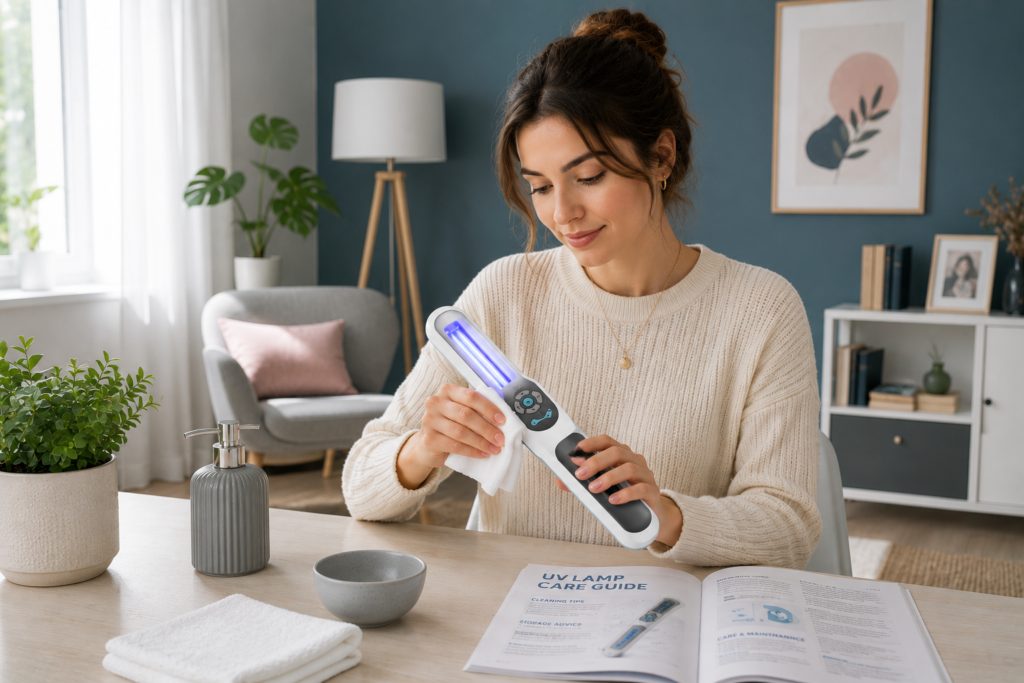
Good uv lamp maintenance buys years of trouble-free service. Wipe lamps and sleeves with a soft cloth and isopropyl alcohol when the unit is off and cool (3). Track your bulb hours and replace on schedule – 9 to 12 months for continuous-duty systems (3)(4). Keep the housing dry, give it some ventilation, and put a surge protector between it and the wall. Run a quick visual inspection every quarter. When you buy replacement parts, look for the UL listing or equivalent certification (9).
Common Mistakes to Avoid
Don’t run a unit with a cracked envelope – the mercury cleanup must follow EPA’s procedure, not a vacuum (8). Don’t touch bulb glass with bare fingers. Don’t substitute non-compatible bulbs or ballasts just because the pins line up. Don’t ignore flicker, alarms, or intermittent starts; they almost always get worse. And don’t disable an interlock to “just check something” – UV-C is invisible, painless during exposure, and damaging within seconds (1)(6).
Conclusion
Most uv light repair work follows the same arc: cut power, inspect, test the supply, check the ballast, swap the bulb. Do that in order and you’ll resolve the majority of faults without a service call. Stay current on uv bulb replacement, keep the quartz sleeve clean, and protect the ballast from surges, and the system will keep doing its job quietly in the background. When the problem touches wiring, control boards, or any UVGI fixture in occupied space, hand it to a qualified pro – the equipment is forgiving, the radiation isn’t.
References
-
U.S. Food and Drug Administration (FDA). UV Lights and Lamps: Ultraviolet-C Radiation, Disinfection, and Coronavirus. https://www.fda.gov/medical-devices/coronavirus-covid-19-and-medical-devices/uv-lights-and-lamps-ultraviolet-c-radiation-disinfection-and-coronavirus
-
FDA. Do Not Use Ultraviolet (UV) Wands That Give Off Unsafe Levels of Radiation: FDA Safety Communication, July 20, 2022. https://www.fda.gov/medical-devices/safety-communications/do-not-use-ultraviolet-uv-wands-give-unsafe-levels-radiation-fda-safety-communication
-
CDC / NIOSH. About Germicidal Ultraviolet (GUV) – Ventilation. https://www.cdc.gov/niosh/ventilation/germicidal-ultraviolet/index.html
-
NIOSH. Environmental Control for Tuberculosis: Basic Upper-Room Ultraviolet Germicidal Irradiation Guidelines for Healthcare Settings. DHHS (NIOSH) Publication No. 2009-105. https://www.cdc.gov/niosh/docs/2009-105/
-
U.S. Environmental Protection Agency, Office of Water. Ultraviolet Disinfection Guidance Manual / Innovative Approaches Toolkit, EPA 815-B-21-007, May 2022. https://www.epa.gov/system/files/documents/2022-05/uv-toolkit-815-B-21-007_0.pdf
-
OSHA. Standard Interpretation – Workplace exposure limits for ultra-violet radiation, February 26, 2003. https://www.osha.gov/laws-regs/standardinterpretations/2003-02-26
-
OSHA. Non-Ionizing Radiation – Overview. https://www.osha.gov/non-ionizing-radiation
-
U.S. EPA. Recycling and Disposal of CFLs and Other Bulbs that Contain Mercury. https://www.epa.gov/mercury/recycling-and-disposal-cfls-and-other-bulbs-contain-mercury
-
UL Solutions. UVC Testing, Certification and Safety Services (ANSI/CAN/UL 8802). https://www.ul.com/services/ultraviolet-uvc-light-testing-and-certification